

ORCHESTRATING SPEECH: THE INTERPLAY OF LINGUISTIC, AGE–, AND DISEASE–RELATED FACTORS IN SPEECH COORDINATION
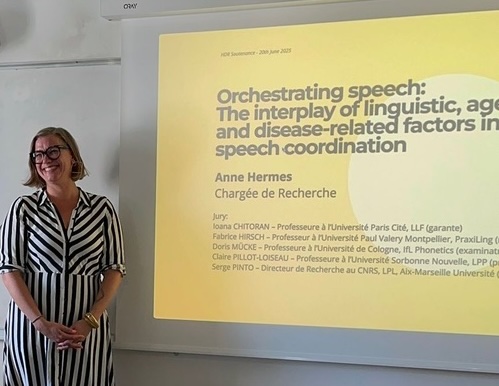 Jury :
- Ioana CHITORAN – Professeure à l’Université Paris Cité, Laboratoire de Linguistique Formelle (garante)
- Fabrice HIRSCH – Professeur à l’Université Paul Valery Montpellier, PraxiLing (rapporteur)
- Doris MÜCKE – Professeure à l’Université de Cologne, IfL Phonetics (examinatrice)
- Claire PILLOT-LOISEAU – Professeure à l’Université Sorbonne Nouvelle, Laboratoire de Phonétique et Phonologie (présidente)
- Serge PINTO – Directeur de Recherche au CNRS, Laboratoire Parole et Langage, Aix-Marseille Université (rapporteur)
Summary:
Speech coordination can be understood as « orchestrating speech, » where parallels are drawn between an orchestra and the elements of speech production. In this analogy, the brain acts as the conductor, coordinating the timing, planning, and execution of speech, while articulators like the tongue, lips, and vocal cords function as instruments, each producing specific sounds similar to how different instruments create unique tones. Phonological rules serve as the score, guiding how sounds are organized including syllable structure, stress patterns, and intonation. The timbre in speech reflects the unique qualities of individual voices, akin to how instruments have distinct timbres, and the act of speaking represents the performance, showcasing the culmination of these coordinated efforts. This analogy highlights the complexity of speech production and the intricate coordination required for effective communication.
Coordinative structures are defined as a collection of different components that are self-organized and simultaneously function together as single coherent units (Bernstein 1967, Kelso 2014) with time and timing play a pivotal role in these coordinative structures. This systemic organization, or temporal patterning, serves as the fundamental basis of speech and language. Uncovering coordinative structures in areas such as articulatory coordination, segmental characteristics, respiratory patterns and phrasing is crucial for understanding how different language systems operate, what variability reveals about these structures, and how external factors such as biological (aging) or pathological (disease) factors interact.
Coordinative structures, which reflect the speaker’s grammatical knowledge, can be found on different levels, from smaller units (e.g., gestures, segments, syllables) to larger prosodic units (e.g., intonational and intermediate/accentual phrases). My research aims to uncover these structures and their variation across different language systems and populations. Studies have shown that these structures are dynamic and flexible rather than static, with their variation influenced by factors such as segmental composition, prosodic structure, speaker-specific traits, speech motor disorders, and physiological changes. These factors serve as both triggers and constraints for variability.
Variation is regarded as a window into linguistic structure, rather than merely « noise » (Mücke & Grice 2014, Vatikiotis-Bateson, Barbosa & Best 2014, Hermes, Mücke & Auris 2017, Mücke, Hermes & Cho 2017). Studying complex linguistic phenomena and their regulating mechanisms behind them enables us to comprehend how much variation is tolerated within a system. As mentioned before, speech systems must be flexible and adaptive to changes over time, responding to the intricate interplay of grammatical, prosodic, and physiological demands. Thus, natural human communication requires both stability and flexibility in coordinative structures, regulated by diverse needs and constraints within each language. My research combines theoretical building for complex linguistic phenomena with experimental explorations in speech. It employs various empirical methods to assess speech production patterns (acoustic and articulatory data analysis), speech planning patterns (respiratory data analysis), and computational simulations of observed speech patterns. The research question that accompanies my research topics since years is: How do linguistic complexity, aging, and disease interact to shape the coordinative structures of speech?
This thesis titled “ORCHESTRATING SPEECH: THE INTERPLAY OF LINGUISTIC, AGE-, AND DISEASE-RELATED FACTORS IN SPEECH COORDINATION”, consists of four major parts. Chapter 1 presents my research related to “Linguistic factors and speech coordination”, with a focus on how linguistic structures are reflected in articulatory coordination. This chapter will present work across different languages (inter alia Italian, Polish, Tashlhiyt Amazigh, Georgian) and different phenomena (inter alia syllable complexity, lexical stress, length contrast, and secondary articulation). Chapter 2 presents my research related to biological factors on speech coordination, specifically on “Age-related factors and speech coordination”. Chapter 3 will give an overview of research I have done within “Disease-related factors and speech coordination”, dealing with speech coordination patterns in Essential Tremor patients, Parkinson’s and also individuals with congenital facial paralysis (Moebius syndrome). Chapter 4 deals with some of the challenges this research is facing and further gives some future avenues, finishing with a conclusion.