

Technical information
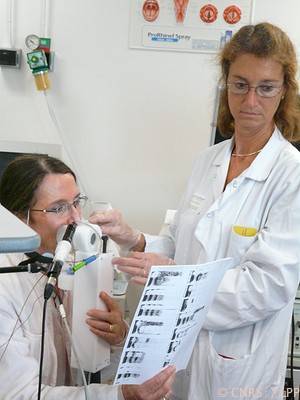
The photonasograph (PNG) was created at the LPP. It is based on light sensing, similar to Ohala’s design, and enables measurement of the opening of the velopharyngeal port.
A sensor and a light source are inserted through a nostril into the buccopharyngeal cavity. The sensor is positioned above the soft palate and the receptor beneath it (or vice versa). The intensity of light that is detected indicates the degree of opening of the velopharyngeal port. No light is detected when the port is closed. The greatest intensity of light is detected during deep breathing. The speech signal and the degree of opening of the velopharyngeal port can be visualized in real time on a screen.
The signals can be recorded to create a database of physiological measures. This method is not very invasive, and it is certainly the most effective means of studying the physiology of nasality, because it gives a direct estimate of the degree of opening of the velopharyngeal port.
The instrument is useful for clinical diagnosis of velopharyngeal insufficiency or fundamental research in phonetics about nasality.