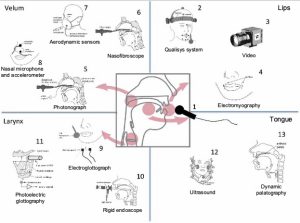

Speech involves coordinated movement by the different articulatory organs, especially the vocal folds, velum (soft palate), tongue, jaw and lips. In phonetics, the shape and movement of these articulators is observed in order to model their behavior in the world’s languages, and in order to synthesize speech, or diagnose speech disorders in a clinical context. These physiological investigations can be carried out using different devices that measure complementary physical properties.
In 2008, the CNRS tasked the Phonetics and Phonology Laboratory with creating a unified instrumentation platform for studying normal and pathological speech. This system includes the following standard instruments:
- a system for high-quality sound recording with a precision sound level meter (1).
- for studying the lips and face: a Qualysis motion-capture system that can accommodate up to 60 sensors and 4 infrared cameras, used primarily for tracking lip movement (2), a professional quality video camera (3), and an electromyograph (EMG) to measure muscular activity (4).
- for studying nasality: a photonasograph to assess the degree of opening of the velopharyngeal port (5), a fiberscope attached to a video camera to examine movement of the velum (6), two aerodynamic systems (EVA2) to collect air flow and air pressure data, both oral and nasal (7), plus nasal microphones and accelerometers (8).
- for studying the larynx: several electroglottographs (EGG) to analyze vocal fold contact (9), fiberscopes and laryngoscopes (10), and two ultra-high-speed video cameras to study vibrations and wave motion in the laryngopharyngeal mucosa.
- for studying the tongue: an ultrasound system housed in the lab, used primarily for visualizing movements of the tongue (12), a system for dynamic palatography and equipment for static palatography which make it possible to observe contact between the tongue and hard palate (13).
The system also includes the following two specially-invented devices:
- The External Lighting & Sensing Photoglottograph (ePGG) enables non-invasive estimation of glottal opening in continuous speech for all sounds, even those further back in the mouth (which is not possible with the devices described above) (11).
- Acoustic-Distortion-Free pneumotachograph, which enables aerodynamic measurements to be made at low cost without the acoustic distortion that is caused by a rigid mask (not possible with the devices described above) (7).