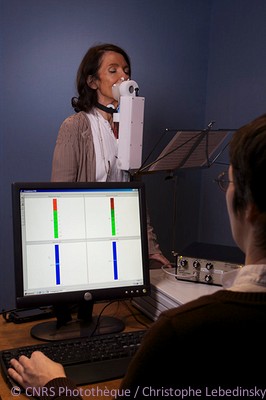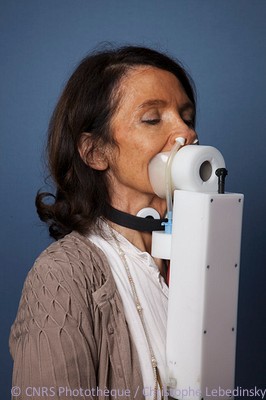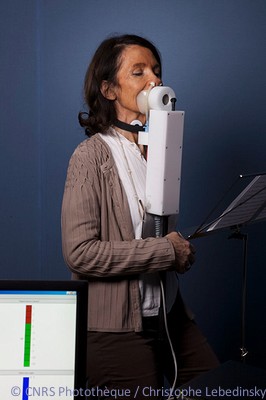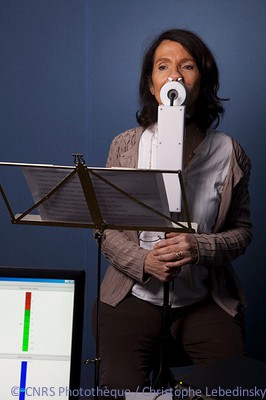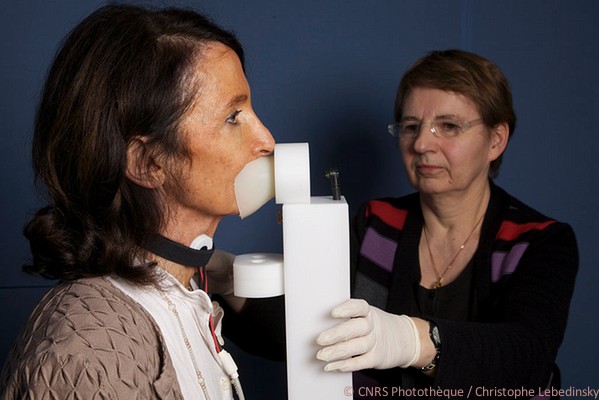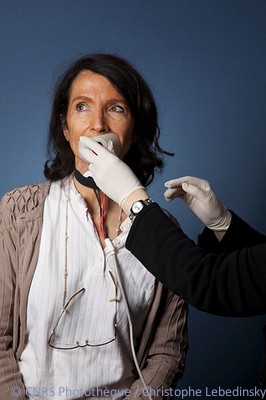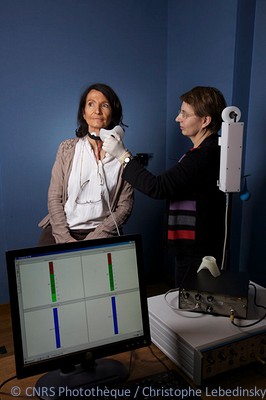


The two electrodes of the electroglottograph (EGG) are placed on the speaker’s neck, one on either side of the larynx. The electroglottographic signal appears as a rapidly varying waveform that corresponds to the opening and closing cycle of the vocal folds, plus a more slowly varying modulation as a function of laryngeal displacement. Signal quality is strongly dependent on careful attachment of the electrodes. The EGG provides a precise and reliable measure of the frequency of vocal fold vibration (fundamental frequency which is perceived as the pitch of the voice), and makes it possible to evaluate the tension of the folds and its effect on voice quality.
Evaluation of aerodynamic properties of sounds, of obstacles to airflow, and of airflow through the different cavities.